For information only: this page does not replace your doctor's advice.
60 to 90%
Resistant hypertension
of people whose blood pressure won't come down with treatment have sleep apnea
No. 1
Underlying cause
of resistant hypertension, ahead of hormonal and kidney causes
2 to 3×
Risk
of having high blood pressure four years later when the AHI is above 5 (Wisconsin study)
How sleep apnea raises blood pressure
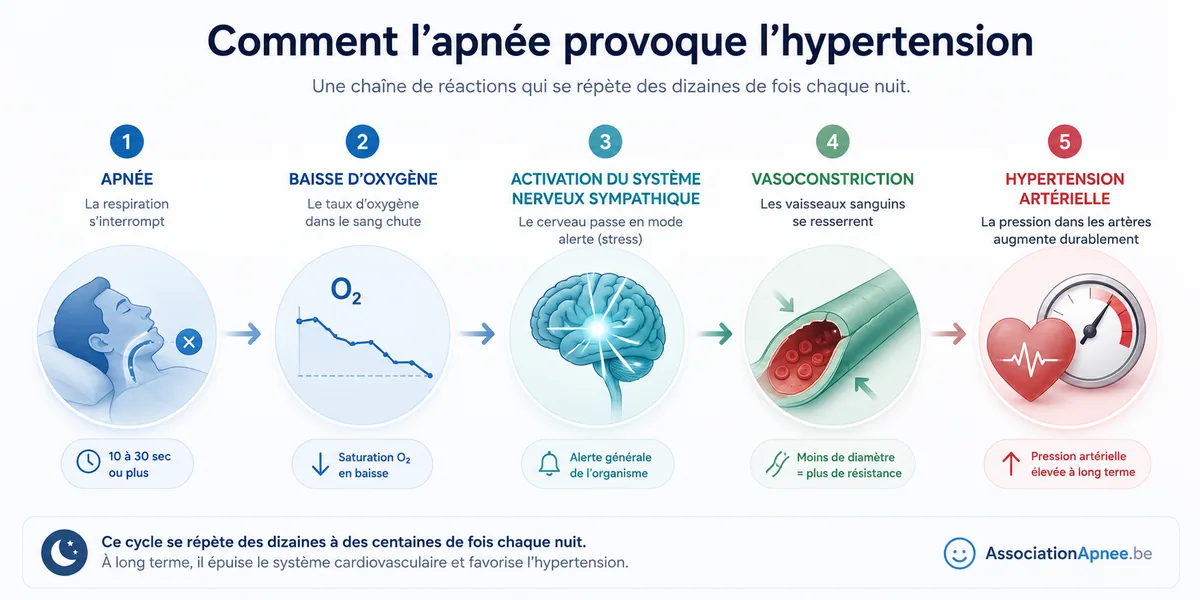
What happens with each apnea
With each apnea, breathing stops, sometimes for 30 seconds or longer, and the oxygen level in your blood falls. Your body treats this as an emergency: the sympathetic nervous system, which drives the stress response, switches on, and a brief arousal from sleep gets you breathing again.
Breathing stops, oxygen drops
The throat closes and airflow stops. In severe sleep apnea, blood oxygen saturation (SpO₂) can fall below 90%.
The stress response kicks in
The drop in oxygen triggers the sympathetic nervous system. The deeper the drop, the stronger the response.
Blood vessels tighten, blood pressure spikes
Blood vessels narrow and the heart speeds up, so blood pressure shoots up during the arousal.
The rise carries over into the day
Repeated dozens or even hundreds of times a night, this cycle helps set up high blood pressure that persists during the day.
Why blood pressure doesn't drop at night
Normally, blood pressure falls by at least 10% while you sleep. Doctors call this dipping.
In people with sleep apnea, repeated arousals keep the stress response switched on all night. Blood pressure drops only a little, or not at all: a non-dipping pattern. The 2024 European guidelines list it among the signs that should make a doctor think of sleep apnea, especially in someone with obesity.
Resistant hypertension: think of sleep apnea
Hypertension is called resistant when blood pressure stays too high despite three medications at the highest dose you can tolerate, one of them a diuretic (water pill), and readings taken outside the doctor's office, at home or over 24 hours, confirm it. Sleep apnea is found in 60 to 90% of these patients. In this group, it is the most common underlying cause.
The evidence
What the studies show
- Wisconsin Sleep Cohort Study (Peppard et al., NEJM 2000): in 709 adults followed for four years, the higher their AHI at the start, the more likely they were to have high blood pressure later. The odds were about twice as high with an AHI of 5 to 15, and almost three times as high above 15, after accounting for weight, neck size, age, alcohol and smoking.
- CPAP meta-analyses : on average, CPAP lowers systolic blood pressure (the top number) by 2 to 3 mmHg (2.6 mmHg across 28 trials, Montesi 2012). The drop is much larger in people whose high blood pressure is not under control: about 7 mmHg (Bakker 2014).
- Why a few mmHg matter : with medication, lowering systolic pressure by 5 mmHg cuts the risk of a major cardiovascular event by about 10% (48 trials, Lancet 2021). CPAP is a different story: the large SAVE trial (NEJM 2016) found no reduction in heart attacks or strokes in people who already had heart or blood vessel disease and used CPAP for 3.3 hours a night on average.
- Resistant hypertension : in the HIPARCO trial (JAMA 2013; 194 patients taking 3.8 blood pressure medications on average), 12 weeks of CPAP lowered average 24-hour blood pressure by 3.1 mmHg more than in the control group. In those who used it at least 4 hours a night, nighttime systolic pressure fell by 7.1 mmHg. More patients also got their normal nighttime dip back (36% vs. 22%).
60 to 90%
of people with resistant hypertension
also have sleep apnea (AHA 2018, ESC 2024).
2 to 3 mmHg
average drop in systolic pressure on CPAP
More when blood pressure is uncontrolled and CPAP is used consistently.
What can CPAP do for my blood pressure?
Realistic expectations
CPAP is not a substitute for blood pressure medication. The two work in different ways and complement each other. Never stop or cut back your medication on your own, even if you feel better after a few weeks on CPAP.
If your blood pressure comes down with treatment, your doctor will decide whether your medication needs adjusting.
What the trials show:
- A modest drop in blood pressure: 2 to 3 mmHg in systolic pressure on average
- A bigger drop when blood pressure is uncontrolled or resistant to treatment
- A better chance of getting back a normal nighttime dip (HIPARCO trial, after 12 weeks)
- No proof so far that CPAP prevents heart attacks or strokes (SAVE trial), though it does improve daytime sleepiness and quality of life
Nightly use is what makes it work
The longer you use CPAP each night, the more your blood pressure comes down. In the HIPARCO trial, the drop grew with hours of use and was more marked above 4 hours a night.
4 hours a night on average is also the threshold the NIHDI (INAMI/RIZIV) CPAP convention sets for reimbursement in Belgium.
Resistant hypertension: ask about a sleep study
Taking three or more medications and your blood pressure is still too high?
If your blood pressure is not under control despite three medications at the highest dose you can tolerate, one of them a diuretic, you meet the definition of resistant hypertension. The 2024 European (ESC) guidelines say sleep apnea should be suspected in everyone in this situation.
Talk to your doctor or cardiologist, who can refer you for a sleep test: respiratory polygraphy, or polysomnography (PSG), the full sleep study and the gold-standard test.
How diagnosis works →Signs that should prompt your doctor to check
Sleep apnea and type 2 diabetes →
Another common link: insulin resistance and HbA1c
Sleep apnea and driving →
Fitness to drive, what to do, and penalties
Sleep apnea treatments
CPAP, oral appliance therapy, surgery: your options and reimbursement
The NIHDI CPAP convention
Who qualifies, what it costs, and how to get reimbursed
Sources
- Peppard PE, et al. Prospective Study of the Association Between Sleep-Disordered Breathing and Hypertension. N Engl J Med. 2000;342(19):1378-1384.
- Montesi SB, et al. The Effect of Continuous Positive Airway Pressure Treatment on Blood Pressure: A Systematic Review and Meta-Analysis of Randomized Controlled Trials. J Clin Sleep Med. 2012;8(5):587-596.
- Bakker JP, et al. Blood Pressure Improvement With Continuous Positive Airway Pressure Is Independent of Obstructive Sleep Apnea Severity. J Clin Sleep Med. 2014;10(4):365-369.
- Martínez-García MA, et al. Effect of CPAP on Blood Pressure in Patients With Obstructive Sleep Apnea and Resistant Hypertension: The HIPARCO Randomized Clinical Trial. JAMA. 2013;310(22):2407-2415.
- McEvoy RD, et al. CPAP for Prevention of Cardiovascular Events in Obstructive Sleep Apnea (SAVE). N Engl J Med. 2016;375(10):919-931.
- Blood Pressure Lowering Treatment Trialists' Collaboration. Pharmacological Blood Pressure Lowering for Primary and Secondary Prevention of Cardiovascular Disease Across Different Levels of Blood Pressure. Lancet. 2021;397(10285):1625-1636.
- Pedrosa RP, et al. Obstructive Sleep Apnea: The Most Common Secondary Cause of Hypertension Associated With Resistant Hypertension. Hypertension. 2011;58(5):811-817.
- Carey RM, et al. Resistant Hypertension: Detection, Evaluation, and Management. A Scientific Statement From the AHA. Hypertension. 2018;72(5):e53-e90.
- Yeghiazarians Y, et al. Obstructive Sleep Apnea and Cardiovascular Disease: A Scientific Statement From the AHA. Circulation. 2021;144(3):e56-e67.
- Cowie MR, et al. Sleep Disordered Breathing and Cardiovascular Disease. J Am Coll Cardiol. 2021;78(6):608-624.
- McEvoy JW, et al. 2024 ESC Guidelines for the Management of Elevated Blood Pressure and Hypertension. Eur Heart J. 2024;45(38):3912-4018.