1 The first night
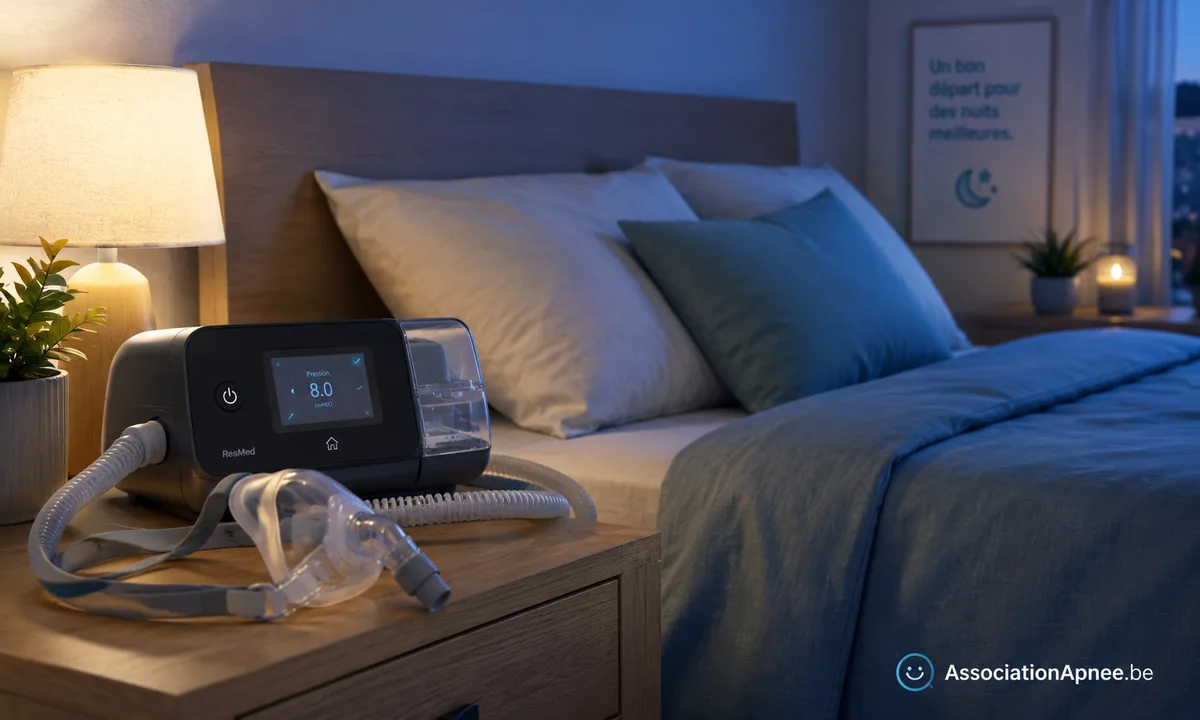
The first night is rarely a complete success, and that is perfectly normal. Your body and brain are discovering something entirely new: a steady flow of air on your face, the quiet hum of the machine (25 to 30 dB, quieter than a fridge), the feel of the mask.
My most useful tip: put the mask on 30 minutes before you turn off the light, with the machine running. Watch TV, read, do something you enjoy. The goal is not to sleep: it is to get used to the feeling, without the pressure of "I have to fall asleep now."
Noise
25-30 dB
Quieter than a fridge. If it whistles, it is the mask, not the machine.
Night 1 goal
Try
No minimum time. One hour is already a start.
If you take the mask off
Put it back
Taking it off is not a failure. Putting it back on is a success.
Breathing through the mouth is common on the first night: if you wake up with a dry mouth, see the humidifier and chin strap below. Above all, do not draw conclusions from a single bad night.
2 The first weeks: what to expect
Getting used to CPAP often follows the same path. At first it is uncomfortable, and that is normal: your body and brain are learning to sleep with something new on your face. Here is what you can reasonably expect.
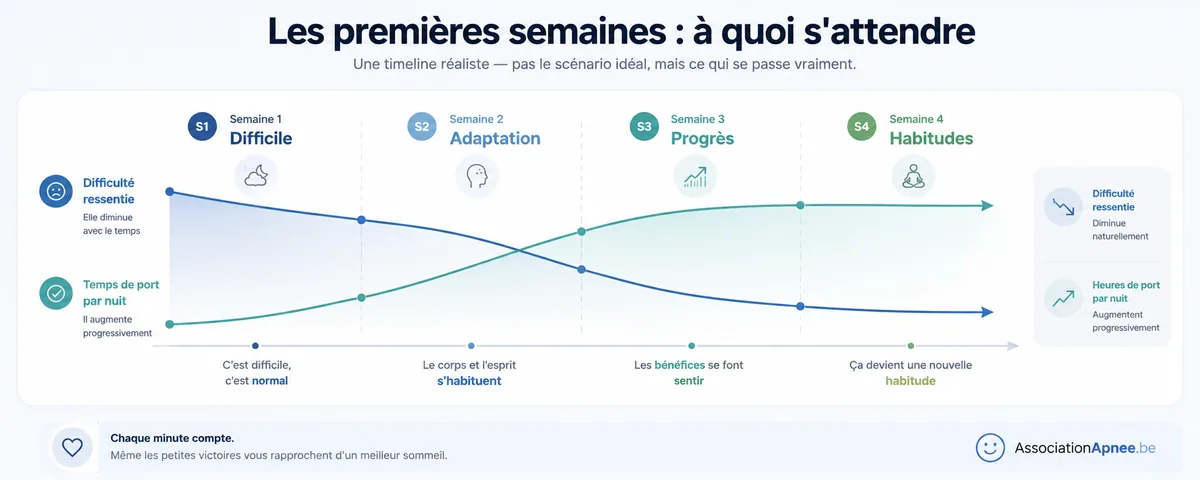
Week 1: adjusting
It is hard, and that is normalLeaks, discomfort, trouble falling asleep with the mask. Waking up often. A feeling of fighting the machine when you breathe out. Perhaps a dry mouth in the morning. All of this is expected.
Goal for the week
Wear the mask 2 to 3 hours a night on average. No more: just get used to it gradually.
Weeks 2-3: progress
Fine-tuningYou sleep longer with the mask. Start fine-tuning: strap tension (one finger should slide underneath), tubing position, humidifier level. If the dry mouth persists, now is the time to turn up the humidifier or try a chin strap.
Goal for this period
Get past 4 hours a night. Find and fix whatever still bothers you.
Week 4: first review
Reading the dataThis is a good time to look at your CPAP report for the first time. Check your residual AHI: ideally below 5, and best of all below 2. If it regularly stays above 5, contact your CPAP provider: the pressure or the mask probably needs adjusting. Do not let it drag on.
Key action
Open your CPAP report and check: residual AHI, leaks (L/min), hours of use.
Months 2-3: comfort sets in
You have made itYou no longer think about putting the mask on: it has become automatic, like brushing your teeth. Daytime alertness often improves: less sleepiness in the afternoon, better focus, a better mood. That is why it is worth sticking with it.
If you are not at this point after 2 months of good use, talk to your sleep doctor: the pressure may need reassessing, or another problem may need looking into.
3 The settings that matter
Heated humidifier
Very helpful, especially in winter when the air is dry. Start around the middle of your machine's setting range, then adjust to how you feel. Too low: dry mouth, blocked nose. Too high: condensation in the tubing, with water gurgling right into the mask. If you have heated tubing (ClimateLine on ResMed machines, for example), use it: it greatly reduces condensation.
Ramp
The ramp starts the machine at a low pressure, then raises it gradually to your treatment pressure over an adjustable time. It makes falling asleep much easier: you do not get the full airflow in your face as soon as you close your eyes. If it is not turned on, look for it in the machine's comfort menu or ask your CPAP provider.
Pressure: do not change it without medical advice
Your pressure is set by your sleep doctor. It is tempting to adjust it yourself, but a pressure that is too high causes leaks, swallowed air and awakenings, while a pressure that is too low does not treat your apneas. If you think it is not right, ask your CPAP provider or your doctor to reassess it: that is their job.
Fixed CPAP or auto-CPAP: what is the difference?
Fixed CPAP
Delivers the same pressure all night. Simple and effective when the pressure has been properly determined. Does not adapt to changes in position or sleep stage.
Auto-CPAP (APAP)
Adjusts the pressure continuously, within a range set by the doctor. The average pressure is often lower, which many patients find easier to tolerate. Your doctor decides between the two.
4 Choosing and fitting your mask
At the start of treatment, the mask is often the heart of the problem, and so of the solution. A mask that does not suit your face or the way you sleep will be uncomfortable, however good the machine. The good news: there are dozens of models, and your CPAP provider is there to help you find the right one.
Golden rules for fitting
- → Snug, not airtight. Slide a finger under the strap: if you cannot, it is too tight. Tightening further to stop a leak often makes it worse.
- → Fit it lying down, not standing up. Your face changes shape when you lie down. Adjust the straps in your usual sleeping position, with the machine running.
- → Still leaking? Try another type. Leaks that persist despite every adjustment often mean the mask type does not suit your face. There are three: nasal pillows, nasal, full face. Careful: never block the small holes in the mask. They are the intentional leak vents, and they are essential to your safety.
- → Replace the cushion regularly. The silicone cushion wears out and stops sealing well. Replace it as often as your mask manufacturer recommends.
To learn all about mask types and how to choose one for your face and sleeping position:
Full guide: choosing a CPAP maskThe NIHDI (INAMI/RIZIV) 4-hour rule
What you need to know to keep your coverage
In Belgium, the NIHDI CPAP convention ties the renewal of your coverage to one condition: at least 4 hours of use a night on average. The average is calculated over at least 2 months at the first renewal, then over at least 9 months for each renewal after that.
It is an average, not a minimum for every night: a 2-hour night can be made up for by a 6-hour night. But a night without CPAP counts as zero. Below 4 hours, a short 3-month approval, the "joker", gives you time to get back above the line.
In practice, if you aim for a full night with the mask, you are comfortably above the threshold, and your treatment works as well as it can.
Common questions from beginners
The real questions everyone asks, with honest answers.
Going further
CPAP gets easier with time and the right tools. These guides will help you progress step by step.
A problem with your CPAP?
Side effects and how to fix them
Dry mouth, leaks, noise, swallowed air... Problems are common at the start. The good news: there is a solution for each one.