Recognizing sleep apnea
The symptoms of sleep apnea
Sleep apnea often creeps in quietly. Many people see their doctor about tiredness or headaches without ever thinking it could be their sleep, and some have hardly any symptoms at all. Here are the signs worth knowing, from the most telling to the easiest to miss.
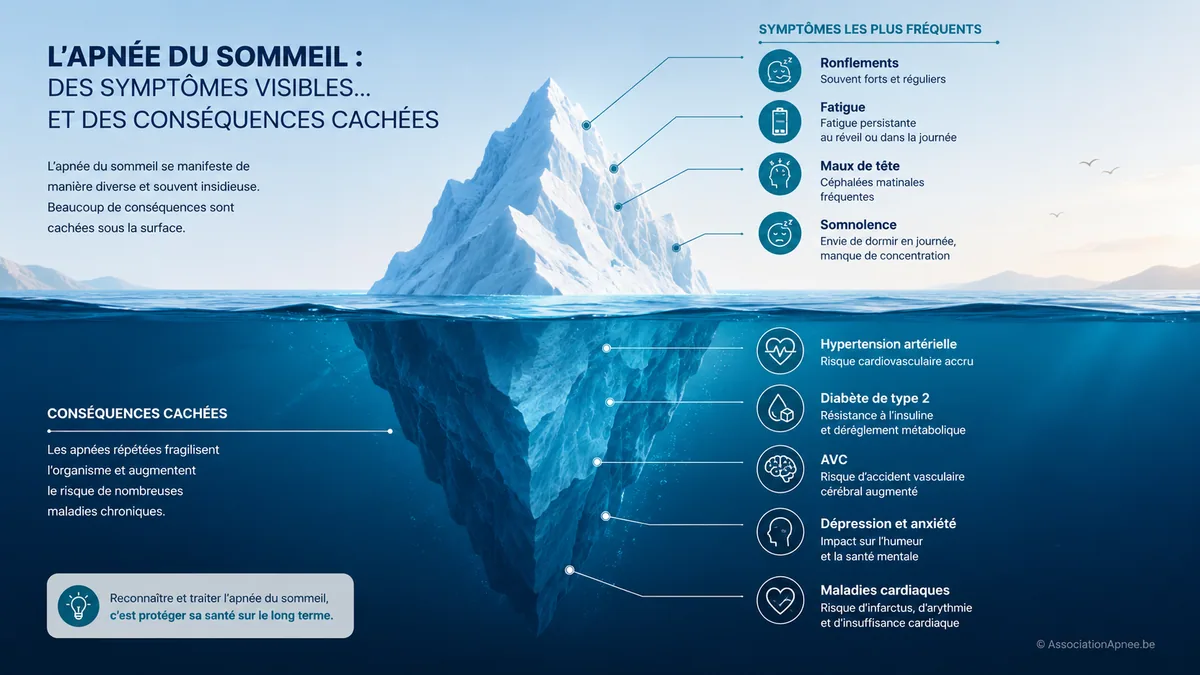
Loud, regular snoring
Key signIt is often the most noticeable sign. Snoring comes from the soft tissues of the throat vibrating as air passes through. Not everyone who snores has sleep apnea, and not everyone with sleep apnea snores: snoring alone can neither confirm nor rule it out.
Pauses in breathing that others notice
Strong warning signYour bed partner notices that you stop breathing during the night, sometimes followed by a snort or a gasp as you start again. It is one of the signs that points most clearly to sleep apnea.
Tiredness and unrefreshing sleep
CommonYou spend 7 or 8 hours in bed and still wake up exhausted. Repeated brief awakenings break up your sleep and make it far less restful, even if you have no memory of them.
Excessive daytime sleepiness
Dangerous when drivingYou doze off without meaning to during the day, especially when you are sitting still: reading, watching TV, sometimes behind the wheel. It is the most common symptom, yet many people with sleep apnea never feel it. Doctors use the Epworth scale to measure it.
Morning headaches
Fairly commonA headache that is already there when you wake up, often on both sides of the head. It lasts less than 4 hours and keeps coming back, sometimes on 15 days a month or more. No one knows exactly what causes it, but it goes away once the sleep apnea is properly treated.
Trouble concentrating and remembering
CommonYou find it hard to focus, you forget things, your head feels foggy. Night after night of broken sleep eventually takes a toll on attention and memory.
Nocturia (getting up at night to urinate)
Often overlookedGetting up twice or more a night to pee. It is often blamed on the bladder or the prostate, but sleep apnea can be the real cause: at night, people with sleep apnea release more of the hormones that make the body flush out salt and water (natriuretic peptides).
Waking up choking or gasping
Warning signYou wake up suddenly, short of breath, sometimes feeling panicky. Tell your doctor right away.
Other related signs
They are less specific, but they can help complete the picture:
Sleep apnea in women: different signs
Women tend to be diagnosed later, because sleep apnea often shows up differently in them. In a study of more than 3,500 patients referred to a sleep laboratory, women were more likely than men to report:
- Insomnia
- Restless legs
- Depression
- Nightmares and a racing heart at night
Menopause matters too. In the Wisconsin Sleep Cohort, women past menopause were 2.6 times more likely to have sleep apnea than women of the same age and weight, and 3.5 times more likely to have moderate to severe sleep apnea.
When should you see a doctor?
Talk to your GP if several of these signs keep coming back, or if someone has seen you stop breathing in your sleep:
- Snoring that people around you have noticed
- Ongoing tiredness even though you get enough sleep
- Sleepiness during the day
- Headaches when you wake up
Frequently asked questions
Next step
Check your risk in 2 minutes
In its validation study, the STOP-BANG questionnaire picked up 93% of moderate to severe sleep apnea. Free, with an instant score and a PDF report to give your doctor.
Sources
- Gottlieb DJ, Punjabi NM. Diagnosis and Management of Obstructive Sleep Apnea: A Review. JAMA. 2020;323(14):1389-1400.
- Gawrys B, Silva TW, Herness J. Obstructive Sleep Apnea in Adults: Common Questions and Answers. Am Fam Physician. 2024;110(1):27-36.
- Headache Classification Committee of the International Headache Society. ICHD-3, 10.1.4 Sleep apnoea headache. 2018.
- Hoshiyama F, et al. The impact of obstructive sleep apnea syndrome on nocturnal urine production in older men with nocturia. Urology. 2014;84(4):892-896.
- Valipour A, et al. Gender-related differences in symptoms of patients with suspected breathing disorders in sleep. Sleep. 2007;30(3):312-319.
- Young T, et al. Menopausal status and sleep-disordered breathing in the Wisconsin Sleep Cohort Study. Am J Respir Crit Care Med. 2003;167(9):1181-1185.
- Chung F, et al. STOP questionnaire: a tool to screen patients for obstructive sleep apnea. Anesthesiology. 2008;108(5):812-821.
Updated November 5, 2026

Andy Leleux
Sleep technologist specialized in CPAP therapy · More than 10 years in sleep medicine
This project rests on more than ten years of clinical work in the sleep laboratory and on a close knowledge of CPAP equipment. That double perspective, clinical and technical, is what Association Apnée is built on.
Was this page useful?
Thank you for the feedback.